Unit C · Circuits and sensing
Measuring distance
What we are making: a machine that measures how far away something is, in centimetres — and then we check whether it is telling the truth.
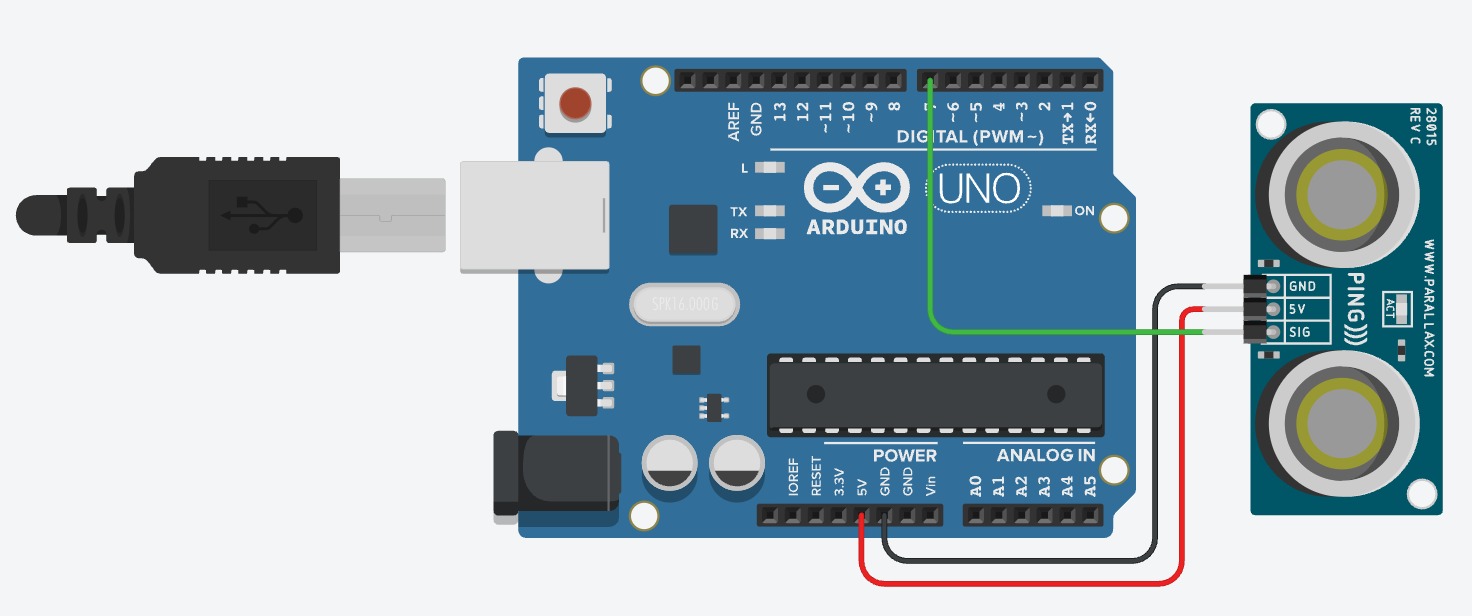
The idea
The two silver cylinders are a speaker and a microphone. The sensor chirps — far too high for you to hear — and then listens for the echo coming back.
Sound travels at a known speed. If the board times how long the echo took, it can work out how far the sound travelled. This is what bats do, and what a ship's sonar does.
Checking whether a sensor is honest
Today you do something engineers do constantly and beginners never do: you check the sensor against something you already trust. A ruler.
If the ruler says 30cm and the sensor says 30cm, good. If the sensor says 34cm, you have just learned something important about your machine — before it mattered.
Wire it up
- Push the sensor into the top of the board so all four pins are in their own columns.
- VCC → 5V, with a red wire.
- Trig → pin 10, with a blue wire. This is the one that sends the chirp.
- Echo → pin 11, with a green wire. This is the one that hears it come back.
- GND → GND, with a black wire.
The code
Try it — against a ruler
- Lay the ruler flat, starting at the front of the sensor.
- Hold a book upright at exactly 10cm. Read what the sensor says.
- Do the same at 30cm, then at 60cm.
- Now find its limits: bring the book slowly closer until the reading stops making sense, then walk it backwards until it gives up.
If it goes wrong
| What you see | Why | What to do |
|---|---|---|
| Always reads 0 | Trig and Echo are swapped. This is the most common fault. | Read the labels printed on the sensor board and match them to pins 10 and 11. |
| Reads a huge number all the time | Nothing is coming back, so it waits and gives up. | Point it at a flat wall about 30cm away. Make sure nothing is right in front of it. |
| Readings jump about by several cm | The surface is at an angle, so the echo bounces away sideways. | Hold the book square to the sensor, not tilted. |
| Works at 30cm but not at 3cm | It is too close — the echo comes back before it has finished chirping. | That is a real limit of the sensor, not a fault. Note it down and design around it. |
What you learned
- Some sensors do their own calculation and answer in real units.
- You check a sensor by comparing it against something you already trust.
- Every sensor has a range where it works and limits where it does not.
- What you point it at changes the answer.
- Measure the same distance ten times and write down all ten readings. Are they identical?
- Find the closest and furthest your sensor can measure at all.